Reading your child’s fitness report without scaring them
Every Texas student in grades 3-12 is tested once a year. Here is what the Healthy Fitness Zone actually means, and the ten minutes that turn a score into a plan.
Sometime this school year your child will run the PACER test in a gym in Corpus Christi — back and forth between two lines while a recording beeps faster and faster — and a few months later a piece of paper or a portal link will land in your hands with words like Healthy Fitness Zone and Needs Improvement – Health Risk on it.
Most parents do one of two things with that report. They throw it away, or they read it out loud at the kitchen table in front of the child. Neither one helps. There is a third way, and it takes about ten minutes.
Why your child gets tested at all
This is not your school being nosy. Texas law requires it. The Texas Education Agency, citing Texas Education Code Sections 38.101 and 38.103, tells every district and open-enrollment charter school that it must assess the fitness level of all students in grades 3–12 who are enrolled in a physical education course or an approved substitute, once a year, and report the results to the state. Districts can use the FitnessGram software under a statewide license, the state’s own PFAI tool, or another vendor.
So the test happens whether or not anyone explains it to you. That is exactly the gap we want to close.
What the zones actually mean
FitnessGram has been used in schools since 1982 and is maintained by the Kenneth H. Cooper Institute. It looks at five things: aerobic capacity, muscular strength, muscular endurance, flexibility, and body composition. Aerobic capacity is usually measured with the PACER, the one-mile run, or the one-mile walk.
Here is the part that matters most, straight from the Cooper Institute: FitnessGram is designed to help a student understand their own health-related fitness, not to compare themselves to other children. It uses criterion-referenced standards, not percentile ranks. Your child is not being graded against the fastest kid in class. They are being compared to a health threshold.
There are three zones for each component:
- Healthy Fitness Zone — at or above the level associated with good health.
- Needs Improvement — below that level.
- Needs Improvement – Health Risk — far enough below that health risk goes up.
Those zones are not arbitrary. In a study of two national samples of U.S. adolescents ages 12–15 (NHANES 2003–2004 and the 2012 National Youth Fitness Survey, published in 2020), teens whose aerobic capacity fell in the FitnessGram high-risk category had about three times the odds of clustered cardiometabolic risk factors and roughly six times the odds of an unhealthy weight status compared with peers in the healthy range. The researchers called their findings partial support for the cut-points — not perfect, but a real signal.
Read it like a coach, not a judge
A fitness report is closer to a tire-pressure gauge than a report card. It tells you what to put air in. Four habits make that possible:
1. Read it yourself first, alone
Whatever your face does when you see the body-composition line, do it in private. The American Academy of Pediatrics has warned clearly that weight-focused talk and teasing at home is associated with harm, not improvement; in one study of teens, 4.2% of those whose families encouraged healthy eating used extreme weight-control behaviors, compared with 23.2% of those whose families talked about weight and dieting. Your first reaction is data your child will remember longer than the score.
2. Start with what is in the zone
Almost every report has at least one component in the Healthy Fitness Zone. Say that one out loud first, by name. “Your curl-ups are right where they should be” is a true sentence and a better opening than silence.
3. Pick one component, not five
If aerobic capacity is low, that is the one to work on, and the fix is minutes, not a diet. Federal guidance is 60 minutes of moderate-to-vigorous activity a day. Texas children average 4.3 days a week of hitting that, and only 23% manage it all seven days, according to the UTHealth Dell Center’s report on 2021–2023 Texas SPAN data. Your child is not unusual. That is the whole point.
4. Bring the paper to the doctor
Put the report in the folder you take to the next well-child visit. Here in Nueces County the context is heavy — 44.0% adult obesity and 15.5% diagnosed diabetes among adults, versus 34.2% and 13.4% statewide, in the 2025 Corpus Christi–Nueces County Community Health Assessment using CDC 2021–2022 data. A pediatrician who can see a fitness trend and a family history in the same visit can make a much better call about screening than one who cannot.
A score is a starting line, not a verdict. Children do not need to be told they are failing. They need somebody to run with them.
What we do with this at Ignite Fit
Ignite Fit is a free ten-week season for children ages 8–17 in Nueces County: 45 minutes of Move, 30 minutes of Fuel, 20 minutes of Faith each week, with a monthly family night. Faith is offered and never required, and the program is open to every family.
The fitness report is where our award ladder starts. Bronze is earned through eight weeks of consistent effort under the Presidential Active Lifestyle Award. Silver is earned by reaching the FitnessGram Healthy Fitness Zone in five of six components. Gold goes further. A child who comes in with two zones missed has something concrete to earn back — not a lecture.
Season One dates will be announced soon. Parents are welcome at every session; no parent is ever asked to drop off and leave.
If you want your child in that first season, or you want to talk through a report you just got, email service@ignitehisglory.com or call 361-765-2126. Bring the paper. We will read it with you.
Sources
- Texas Education Agency – Annual Physical Fitness Assessment Reporting (Aug 17, 2023): Texas Education Code 38.101 and 38.103 require annual fitness assessment for grades 3-12 in PE, reported to the state.
- Kenneth H. Cooper Institute – FitnessGram assessment: five health-related components, criterion-referenced standards rather than percentile norms, and the three fitness zones.
- Jung et al., 2020 (PMC7248668) – Testing validity of FitnessGram cardiorespiratory fitness cut-points in two samples of US adolescents ages 12-15 (NHANES 2003-2004; NNYFS 2012).
- UTHealth Houston, Michael & Susan Dell Center – Child Physical Activity in Texas (2021-2023 Texas SPAN data, updated Aug 4, 2025): 23% active 60+ minutes on all 7 days; 4.3 days/week average.
- Pont et al., Pediatrics 2017 (PMID 29158228) – AAP policy statement on stigma experienced by children with obesity; and Bauer et al., 2013 (PMC4081797) – family weight talk and extreme weight-control behaviors (4.2% vs 23.2%).
- 2025 Corpus Christi-Nueces County Community Health Assessment – adult obesity 44.0% and diagnosed diabetes 15.5% in Nueces County (CDC PLACES/BRFSS 2021-2022).
Not medical advice. Ignite His Glory is a community and faith organization, not a healthcare provider. We explain publicly available guidance so families can have better conversations with a doctor. Always talk with your child’s clinician before changing diet, exercise or any medication.
Ten weeks. One coach. No cost to your family.
Ignite Fit puts this into practice for children ages 8 to 17 in Corpus Christi — movement, a teaching kitchen and a family that learns alongside the child.
More from the blog.

Fish on Friday, cake on the feast: the Church’s calendar at your family table
What Catholic fasting and abstinence actually ask (and never ask of children), why shared meals matter, and a simple feast-and-fast calendar for this fall.
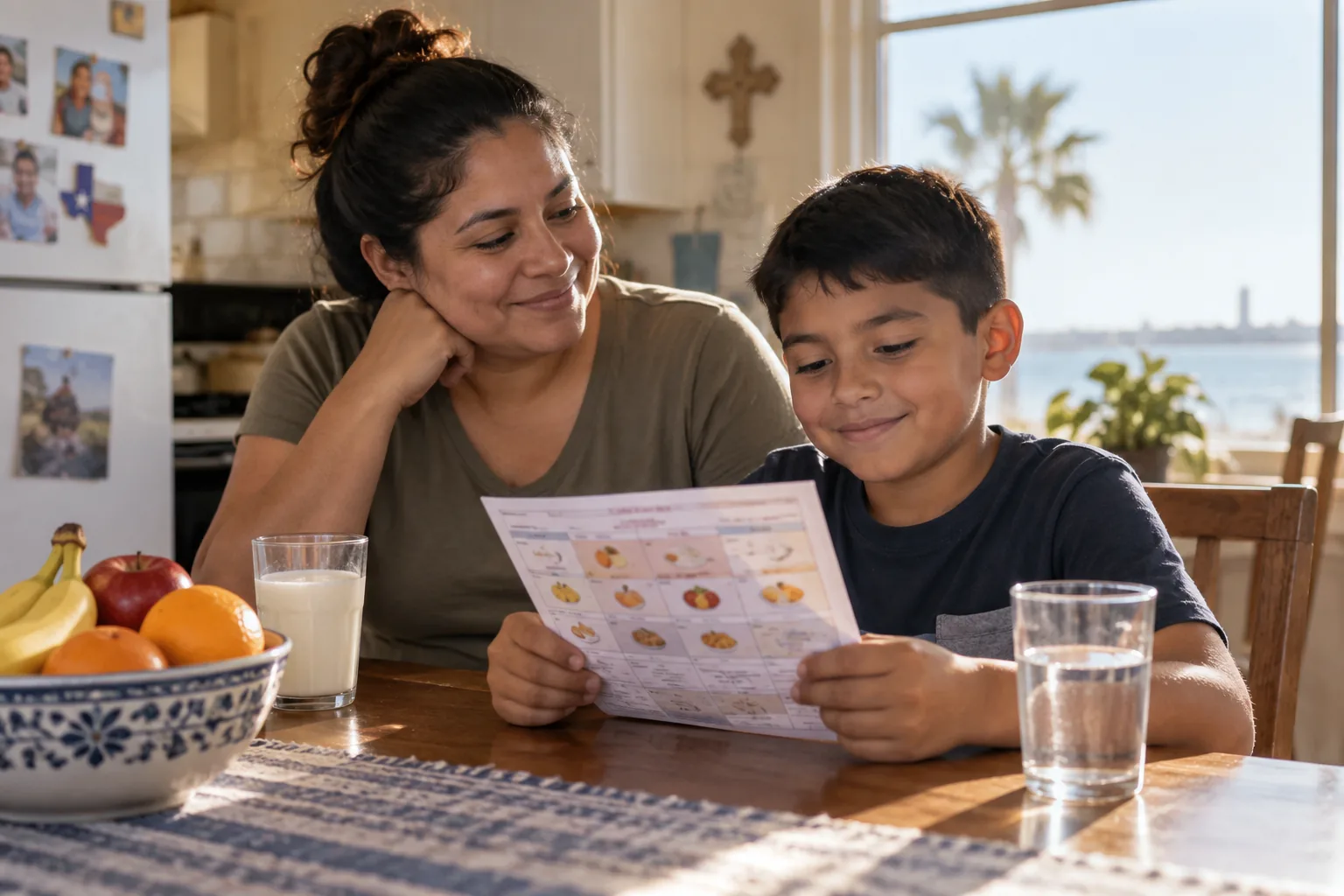
Whole milk is back on the school lunch tray. What should your child drink at home?
A new federal law lets schools serve whole milk again, and the new Dietary Guidelines favor full-fat dairy, while pediatricians’ guidance still says low-fat after age 2. Where the experts agree, where they don’t, and what matters more than fat.

Brother Sun, Sister Water: a St. Francis walk with your child this weekend
For the feast of St. Francis on October 4: how to pray his Canticle of the Creatures on a one-hour family walk, why time outside matters for Texas kids, and how to keep it safe in South Texas sun.